PREVIOUS
Caltta Demonstrates Strong MCX Interoperability at the 10th ETSI MCX Plugtests in France



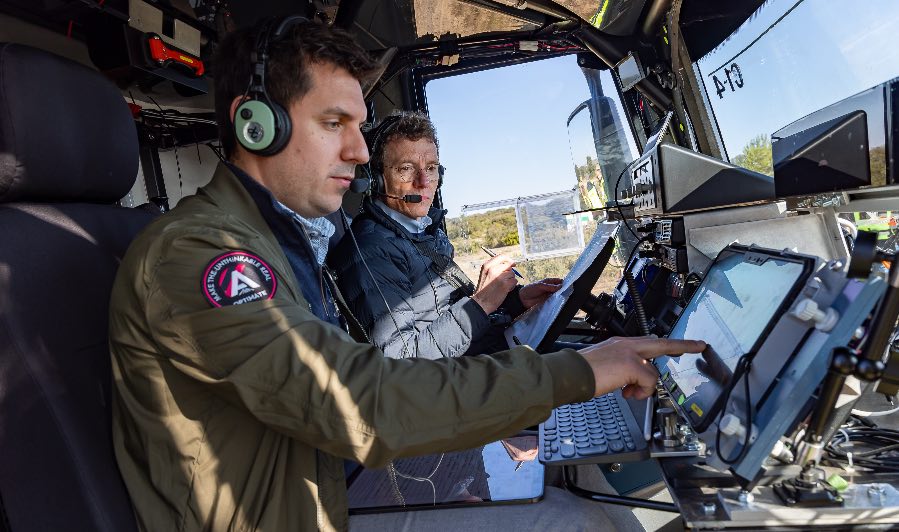
At Interschutz 2026, Airbus Defence and Space unveiled Wildfire Sentinel, a comprehensive digital ecosystem designed to transform wildfire management through real-time data integration, advanced aerial capabilities, and seamless coordination between ground and air operations.
As wildfires continue to intensify in frequency, scale, and complexity worldwide, Wildfire Sentinel introduces a new operational model that shifts firefighting from reactive response to proactive, intelligence-led intervention. The solution creates a resilient digital framework that enables emergency services to detect, assess, coordinate, and suppress wildfires with unprecedented speed and precision.
Unlike traditional firefighting approaches that rely heavily on voice communications and fragmented situational awareness, Wildfire Sentinel integrates satellite intelligence, unmanned aerial systems, tactical communications networks, artificial intelligence, and aerial firefighting assets into a single connected environment. The result is a real-time Common Operational Picture that supports faster decision-making, enhanced safety, and more effective resource deployment.
At the core of the solution is a highly adaptable modular architecture designed to integrate with existing firefighting infrastructure. Airbus combines its expertise in aircraft, communications, flight operations, satellite services, and unmanned systems with specialized partner technologies to deliver a scalable ecosystem tailored to regional requirements and operational environments.
Wildfire Sentinel operates through an end-to-end mission cycle consisting of eight interconnected operational phases: Prepare, Connect, Observe, Localise, Collaborate, Command, Suppress, and Replay.
The system begins by leveraging Airbus OneAtlas satellite imagery to identify high-risk areas and support mitigation planning. Through Agnet by Airbus, it establishes resilient tactical communications networks that connect field personnel, command centers, and aircraft via LTE, satellite communications, and mesh technologies.
For situational awareness, Wildfire Sentinel integrates data from Airbus unmanned aerial platforms, including Aliaca, Flexrotor, SiRTAP, and Zephyr, delivering real-time visual and infrared intelligence to support operational planning and fire monitoring. Universal tracking and three-dimensional georeferencing capabilities provide precise location data for all personnel, vehicles, and aircraft, reducing operational risk and eliminating uncertainty in complex environments.
The ecosystem further enhances firefighting effectiveness through Airbus Optimate, an AI-powered platform that calculates optimal water-drop trajectories and provides immediate impact assessments. Mission commanders benefit from centralized command and control capabilities, automated deconfliction functions, and real-time hazard notifications that improve coordination across multiple agencies and response teams.
For suppression operations, Wildfire Sentinel integrates Airbus’ extensive aerial firefighting portfolio, including the H125, H145, H215, and H225 helicopters, alongside fixed-wing platforms such as the A400M and C295. The ecosystem is also designed to support future-generation assets, including HYNAERO’s Fregate F100 amphibious water bomber.
Following each mission, the Replay function generates a complete digital reconstruction of operational activities, enabling comprehensive after-action reviews, performance analysis, and advanced training programs to continuously improve response effectiveness.
A key advantage of Wildfire Sentinel is its ability to replace traditional voice-based coordination with real-time visual intelligence. By combining high-resolution satellite imagery from the Pléiades Neo constellation with live infrared drone feeds, emergency services gain immediate situational awareness and can act before small ignitions escalate into large-scale wildfires.
The effectiveness of this approach was demonstrated during a major field trial conducted in March 2026 in Nîmes, France, in collaboration with the French Fire and Rescue Services (SDIS) and Entente Valabre. The exercise validated how real-time data fusion can significantly reduce the time between fire detection and suppression, improving operational outcomes while enhancing firefighter safety.
With Wildfire Sentinel, Airbus is expanding its role from a provider of individual aerial assets to a strategic partner delivering a fully integrated wildfire management ecosystem. By connecting satellites, drones, communications networks, command systems, and aerial firefighting resources into a unified operational framework, Airbus aims to help emergency services worldwide respond faster, operate safer, and better protect communities and natural environments from the growing threat of wildfires.