PREVIOUS
Thales Launches Denmark Connectivity Lab for Next-Generation Defence Networks



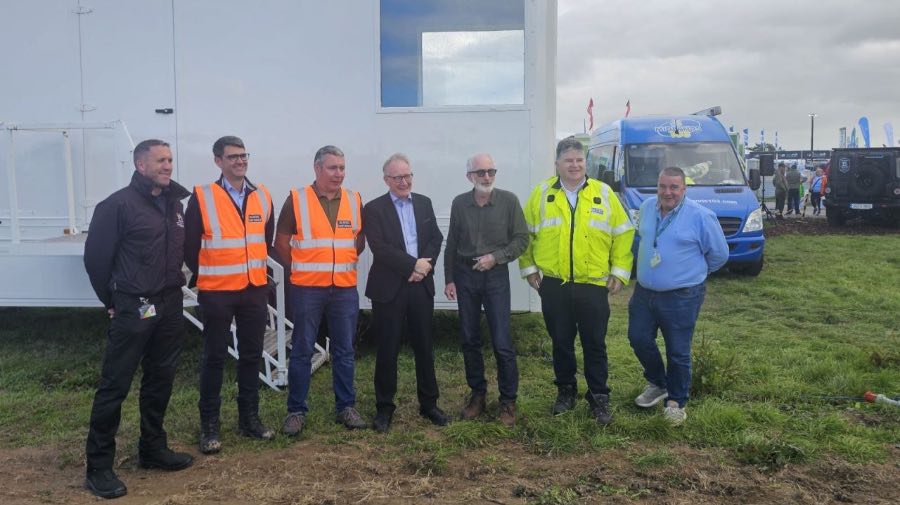
Ireland – September 2026 — Ireland has introduced a national mobile roaming capability for government-issued handsets used by first responders, enabling eligible devices to connect across the country's three major mobile network operators — Vodafone Ireland, eir and Three Ireland.
The capability, demonstrated at the National Ploughing Championships, allows public protection and disaster relief (PPDR) personnel to access an alternative mobile network if the infrastructure of one operator is degraded or unavailable.
Druid Software's Raemis 5G platform forms a key component of the roaming architecture, providing the mobile core capabilities required to support connectivity across multiple operators.
The initiative marks a significant development in Ireland's approach to public-safety communications. By moving beyond dependence on a single mobile network, government users can access multiple network infrastructures, helping maintain communications and access to operational information during network disruption or localized coverage issues.
For emergency personnel, access to mobile connectivity is increasingly important for voice communications, operational data and access to critical information. Network outages, infrastructure damage and periods of high traffic can all affect connectivity during major incidents.
The new arrangement gives participating emergency-service devices access to all three national mobile networks, expanding coverage options across Ireland and providing greater flexibility when individual network services are unavailable.
Speaking at the National Ploughing Championships, Jack Chambers, Minister for Public Expenditure, Infrastructure, Public Service Reform and Digitalisation, said the arrangement would help emergency personnel maintain access to critical information and communications services regardless of which mobile network is available at a particular location.
“It is a practical improvement that will strengthen resilience, support public safety and help prepare Ireland's emergency services for the next generation of critical communication technologies,” Chambers said.
Frank Feighan, Minister of State with Responsibility for Public Procurement, Digitalisation and eGovernment, said the initiative followed sustained engagement between Ireland's Office of the Government Chief Information Officer (OGCIO), the three mobile network operators and Druid Software.
He said the agreement would allow emergency-service devices to access every mobile network in the country, improving coverage, resilience and service continuity.
The Irish deployment also aligns with the broader European development of next-generation public-safety communications under the EU Critical Communications System (EUCCS) initiative led by the European Commission's Directorate-General for Migration and Home Affairs (DG HOME).
EUCCS is intended to support interoperable, high-capacity communications for public protection and disaster relief organizations across Europe. Ireland's multi-network roaming deployment provides a practical example of how commercial mobile infrastructure can be incorporated into a national critical-communications architecture.
The initiative also reflects the wider transition from traditional narrowband public-safety networks toward 4G and 5G-based mission-critical communications, enabling emergency agencies to combine voice with higher-bandwidth applications such as real-time video, location services, situational awareness and operational data.
The introduction of nationwide multi-operator roaming establishes a new layer of connectivity for Ireland's government and emergency services.
By enabling authorized devices to move between three national mobile networks, the arrangement reduces reliance on any single operator and creates a foundation for further development of broadband mission-critical communications in Ireland.
As European public safety organizations continue their migration toward 4G/5G-enabled communications, Ireland's deployment demonstrates how multi-operator connectivity can complement existing public-safety infrastructure and support more flexible, data-rich communications for first responders.