PREVIOUS
FirstNet Fusion Goes Live Nationwide as AT&T Expands Interoperable MCPTT for First Responders



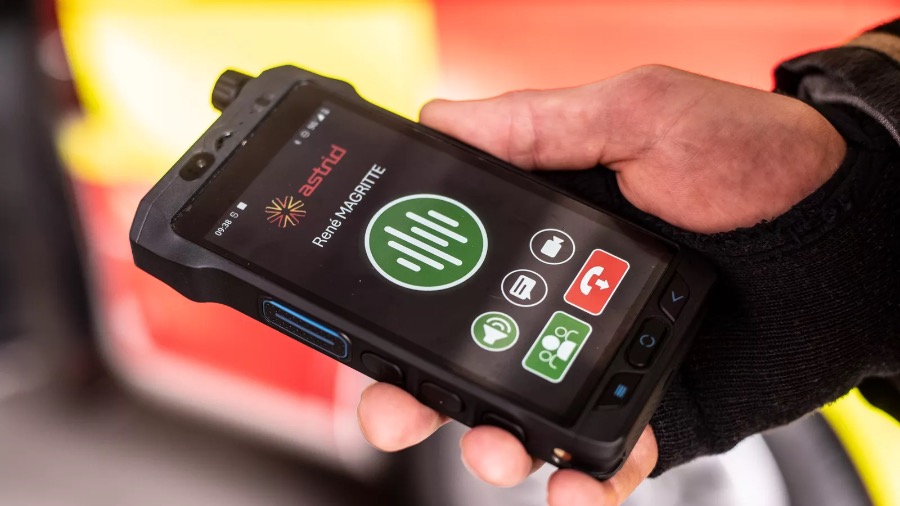
While several devices are already available on the market, the technology continues to evolve rapidly. As a result, it is difficult to predict exactly what NextGenCom devices will look like when ASTRID and its users are ready to make the transition. One thing is certain: the migration from TETRA to mobile broadband will unlock new operational capabilities for frontline users.
The TETRA radio, used by many emergency response and public safety organisations, was primarily designed to provide highly reliable voice communications. Rugged and easy to operate, the device is optimised for use on the ASTRID network. Its functionality is intentionally focused on mission-critical communications, with group calls, individual calls, and the emergency button serving as its core features. In addition, the closed architecture of the system limits opportunities for future expansion or the integration of additional applications.
By contrast, a NextGenCom device can be viewed as a rugged smartphone or tablet with a form factor specifically designed to meet the operational requirements of mission-critical communications users. These devices run on Android, the same operating system used by many commercial smartphones. This provides significantly greater versatility, enabling users not only to make voice calls but also to access data, video, and professional applications.
To ensure reliable operation, robust security, and efficient device management, every NextGenCom device relies on two essential software components: an MDM solution and an MCX application.
Mobile Device Management (MDM) enables organisations to centrally manage and secure their mobile devices. Through the MDM platform, administrators can remotely deploy applications, configure device settings, and enforce security policies. In the event that a device is lost or stolen, it can be locked or wiped remotely to protect sensitive information. MDM ensures that every device complies with the highest security standards while remaining continuously updated and operational.
The MCX (Mission Critical Services) application replaces the traditional communication functions provided by TETRA radios. Through this application, users can perform mission-critical push-to-talk (MCPTT) communications comparable to those available on TETRA, but over ASTRID's future 4G/5G broadband mobile network.
Beyond voice communications, MCX also enables advanced video and data capabilities, including live video streaming from incident scenes, real-time information sharing between emergency services, and secure mobile access to operational databases.
In summary, the industry is transitioning from a dedicated voice communication device to a versatile mission-critical communications platform. While TETRA radios continue to set the benchmark for simplicity and highly reliable voice communications, NextGenCom devices deliver significantly enhanced capabilities across data, video, and professional applications, all supported by centralised device management through MDM.
These innovations are achieved without compromising the ruggedness, availability, and security that remain fundamental requirements for mission-critical communications. Furthermore, organisation-specific applications can be securely integrated while maintaining the stringent security standards required by public safety and critical communications users.
Translated by ChatGPT, Read the full article in French