PREVIOUS
Digitalk Announces Agreement to Be Acquired by Hansen Technologies



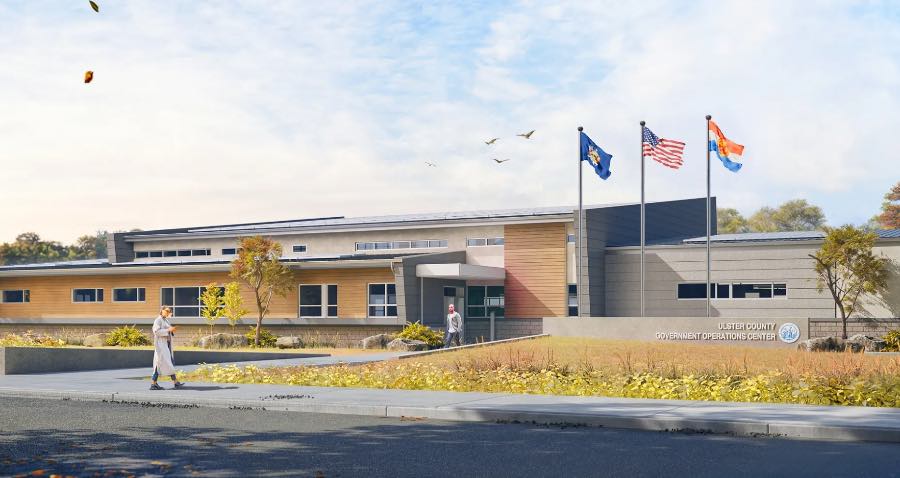
Construction is progressing on a new, state-of-the-art Ulster County Emergency Communications Center (ECC) that will significantly enhance 911 operations, inter-agency coordination, and regional emergency response across New York’s Hudson Valley.
Launched in May with a formal groundbreaking ceremony, the project brings together Ulster County officials, emergency services leaders, and a multidisciplinary design and construction team led by Urbahn Architects, with The Palombo Group as construction manager and Alfandre Architecture as consulting architect. The new ECC is designed to provide a resilient, future-ready hub for life-saving communications and crisis management.
Ulster County’s current Emergency-911 center handles more than 130,000 emergency and non-emergency calls each year, but the existing facility can no longer meet the operational demands of a growing population of more than 183,000 residents. The new 16,350-square-foot ECC will replace the aging center with a modern, hardened, and highly redundant communications facility.
“At the heart of the new ECC is a mission-critical communications environment built for today’s risks and tomorrow’s emergencies,” said Donald E. Henry Jr., AIA, LEED AP, CPHC, Managing Principal at Urbahn Architects. “This facility is designed to ensure that emergency calls are answered, responders are coordinated, and vital information keeps flowing — even during extreme events.”
The new complex will include:
A 3,500-square-foot Public Safety Answering Point (PSAP) with capacity for up to 14 dispatchers and room for future growth
A 3,600-square-foot Emergency Operations Center (EOC) for multi-agency coordination during major incidents
A 975-square-foot IT and server room supporting resilient and secure communications
A 1,600-square-foot Department of Emergency Services (DES) office
A dedicated decompression room to support dispatcher wellbeing after high-stress calls
With a total project budget of $34.5 million, the ECC represents one of Ulster County’s largest investments in public safety infrastructure. Funding includes County bonding, an $18 million capital reserve, and a $2 million NYSERDA grant to support advanced energy and resilience features.
The ECC is being designed as a climate-resilient, always-on communications hub, incorporating:
Geothermal heating and cooling
Super-insulated concrete walls
Rooftop solar panels and battery backup
A planned ground-mounted solar array to provide 100% renewable energy for the facility and other County buildings
These systems ensure that 911 and emergency coordination remain operational during power outages, storms, and regional disruptions.
The 57.3-acre ECC site on Paradies Lane was selected for its proximity to major transportation corridors, the New York State Thruway, and access to robust electrical and telecommunications infrastructure. Approximately 6.5 acres will be dedicated to the ECC, including access roads, a 71-space parking area, and secure landscaping designed for emergency vehicle movement.
According to Christopher Young, AIA, Associate Principal at Urbahn Architects, “Ulster County made it clear that resiliency, redundancy, and reliability were top priorities. From ballistic-resistant windows and hardened walls to redundant ventilation and power systems, this building is designed to keep emergency communications running under the most demanding conditions.”
The ECC will also incorporate secure 911 dispatch workstations, advanced IT and telecom infrastructure designed by Cerami Associates, and specialized wiring and cabling systems developed with Xybix Systems to support high-availability, low-latency emergency communications.
Advanced Building Information Modeling (BIM) technology is being used to coordinate complex electrical, data, HVAC, and communications systems—ensuring precise integration of every mission-critical component before installation.
When completed, the Ulster County ECC will serve as the nerve center for emergency communications and crisis coordination, enabling faster response times, better situational awareness, and greater resilience for the entire region.
Read more here.